
Proof of Concept
Live Demonstration
Twelve rooms above the tree line. Walk it before you visit.
Proof of concept. A scroll-driven real-estate walkthrough with one invented listing. The listing, price and agent are fictional, and the imagery is AI-generated and disclosed on the page. Not a commissioned client project.
01 · Purpose
Vertex shows how a property can be presented as one continuous walk instead of a gallery of thumbnails: a drafted blueprint of the front elevation builds into the finished house, the camera pushes to the front door, and the visitor walks through twelve rooms ending at a viewing request.
Disclosure. Ridgeline House is an invented listing. Its name, address, agent, price and specifications are not real, and its images are AI-generated concept images.
02 · The problem
High-end listings are usually a grid of photographs. A buyer browsing on a phone cannot feel how the rooms connect, and a developer or agent has little to show that a competitor's listing does not also show.
The business it represents. A fictional high-end residential listing presented as a scroll-driven walk.
Who it serves. Buyers browsing homes on a phone, and the agents and developers who want a listing to stand out from a grid of thumbnails.
Deployment status
Publicly reachable without signing in. Opened anonymously on 2026-11-09 and the page loaded.
The listing is invented. The source is on an unmerged branch of the STS framework repository, so the public page is a demonstration deployment, not a released product.
Status checked on 2026-11-09. A status is a statement about what was tested that day, not a promise about tomorrow.
03 · Design approach
A blueprint blue opening that resolves into dusk photography, then a warm walnut and tan palette with one family of type (Archivo). A single thin line, the vertex line, joins the rooms. The page steps back so the house carries it.
04 · Annotated desktop captures
Real captures of the published site. Numbered points are explained as the camera moves to each one.
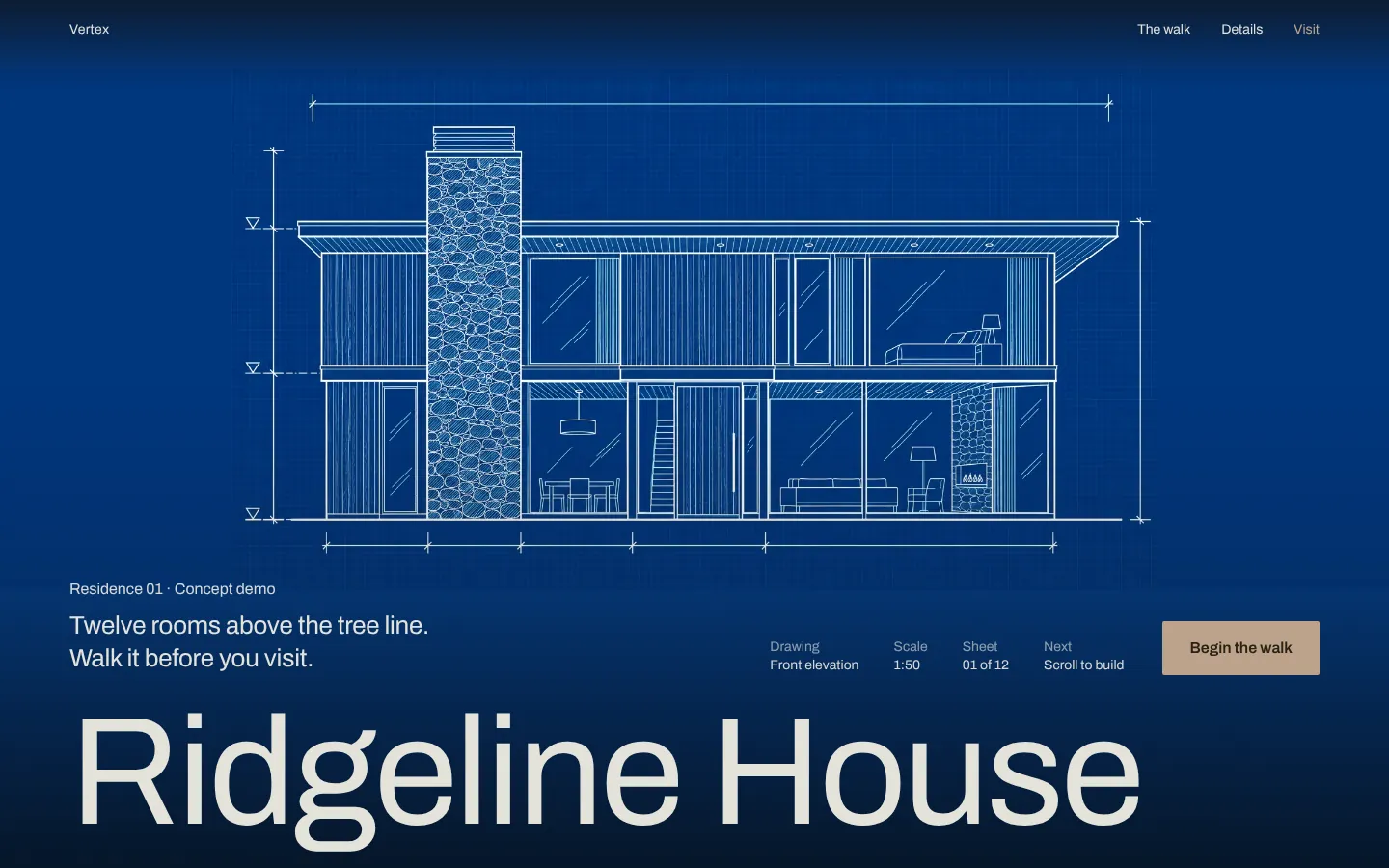
Blueprint
The front elevation is drawn as a drafting sheet, the first state of the house.
Title block
Drawing, scale, sheet number and what comes next, like a real set of plans.
One action
A single tan button begins the walk.
Wordmark
The house name sits along the bottom edge like a film title.
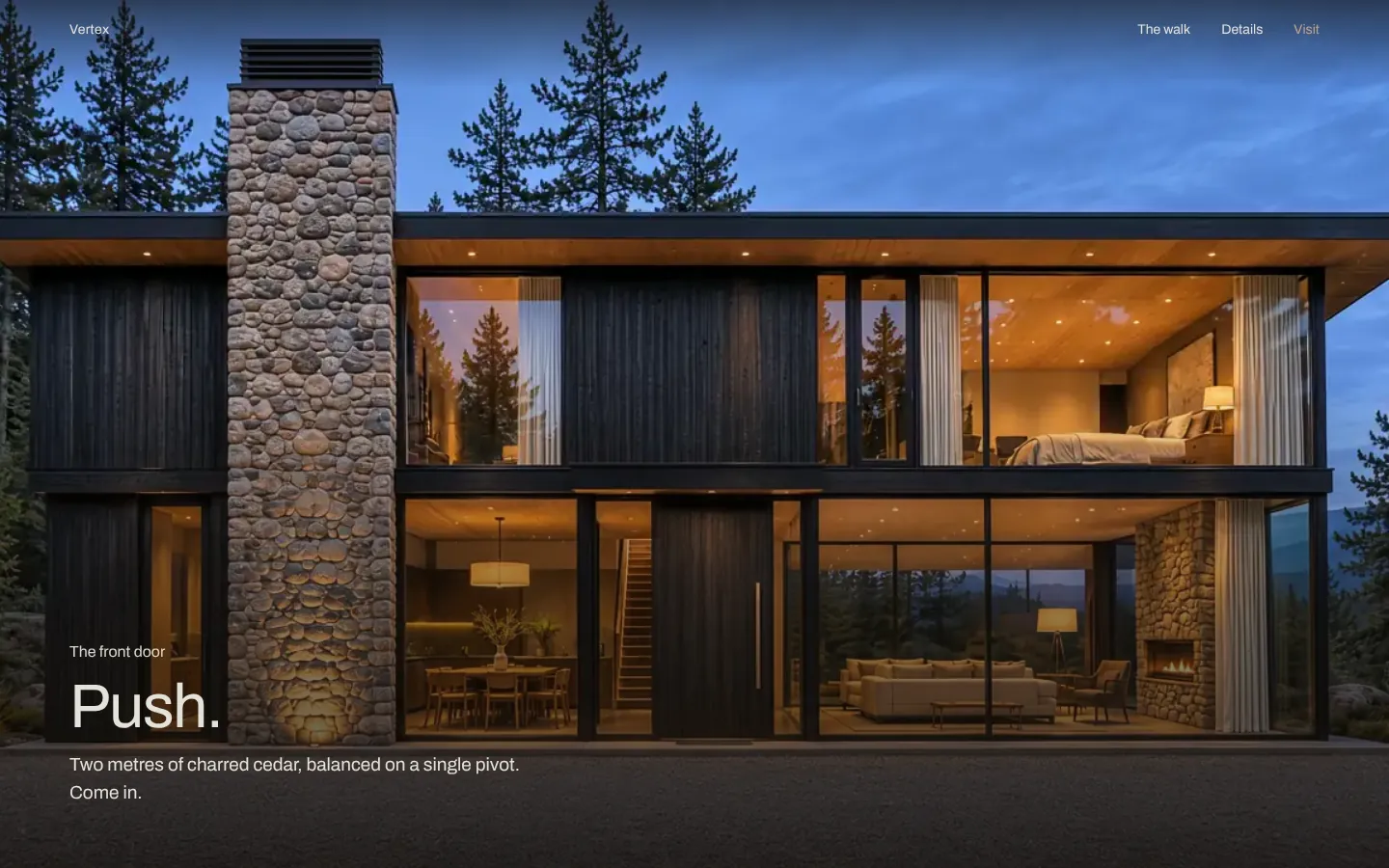
River-stone chimney
A feature of the drawing that is still the same in the finished picture.
Pivot door
The scroll pushes toward the door before the first room.
Caption
Short, physical copy: materials and measurements instead of adjectives.
05 · Responsive behaviour
From desktop to phone
05 · Responsive behaviour
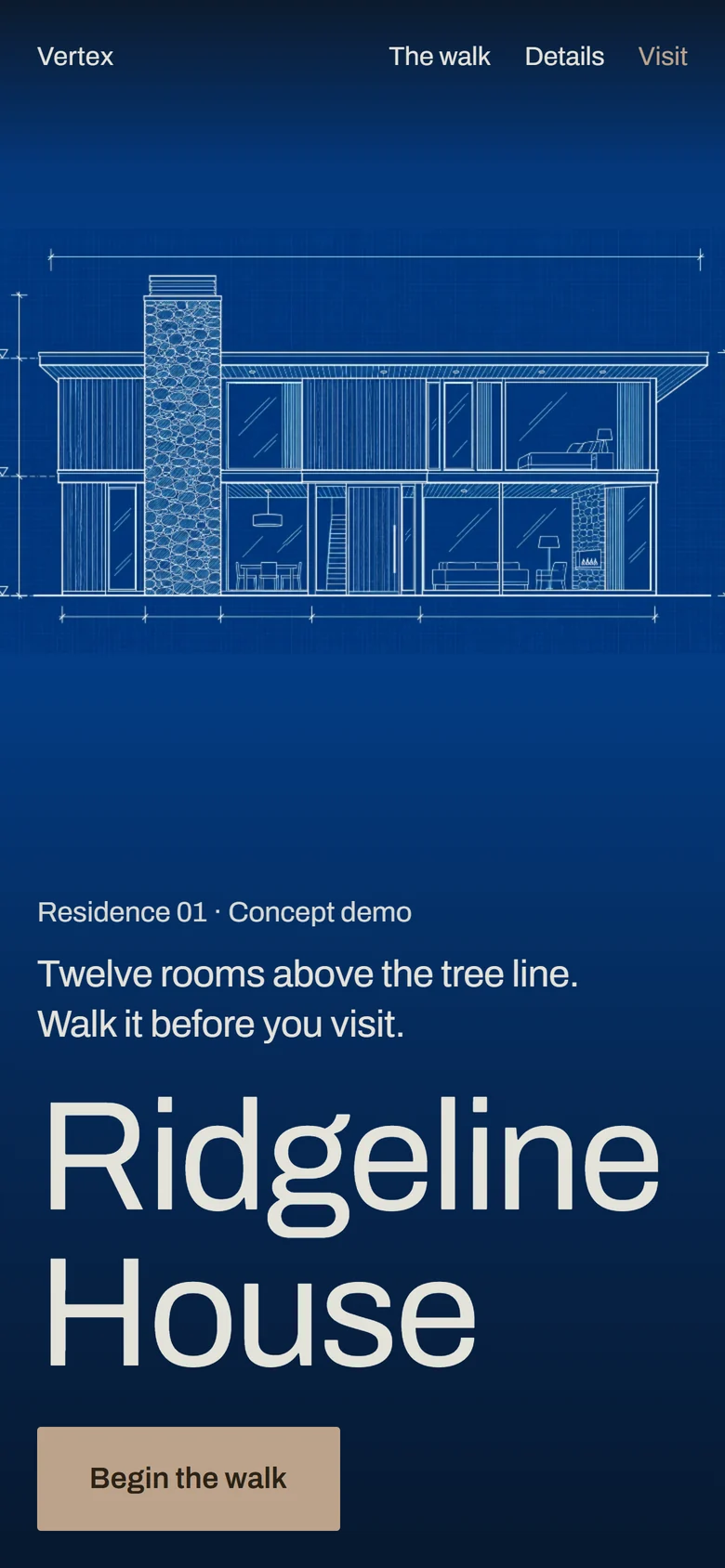
The blueprint and headline stack in a single column on a phone with the call to action beneath, the pictures use their own portrait crops and focal points, and the scroll stays native.
06 · Annotated mobile captures
Blueprint
The same drawing, scaled to the width of a phone.
Wordmark
Stacks to two lines on a narrow screen.
Action
The call to action is reachable by thumb.
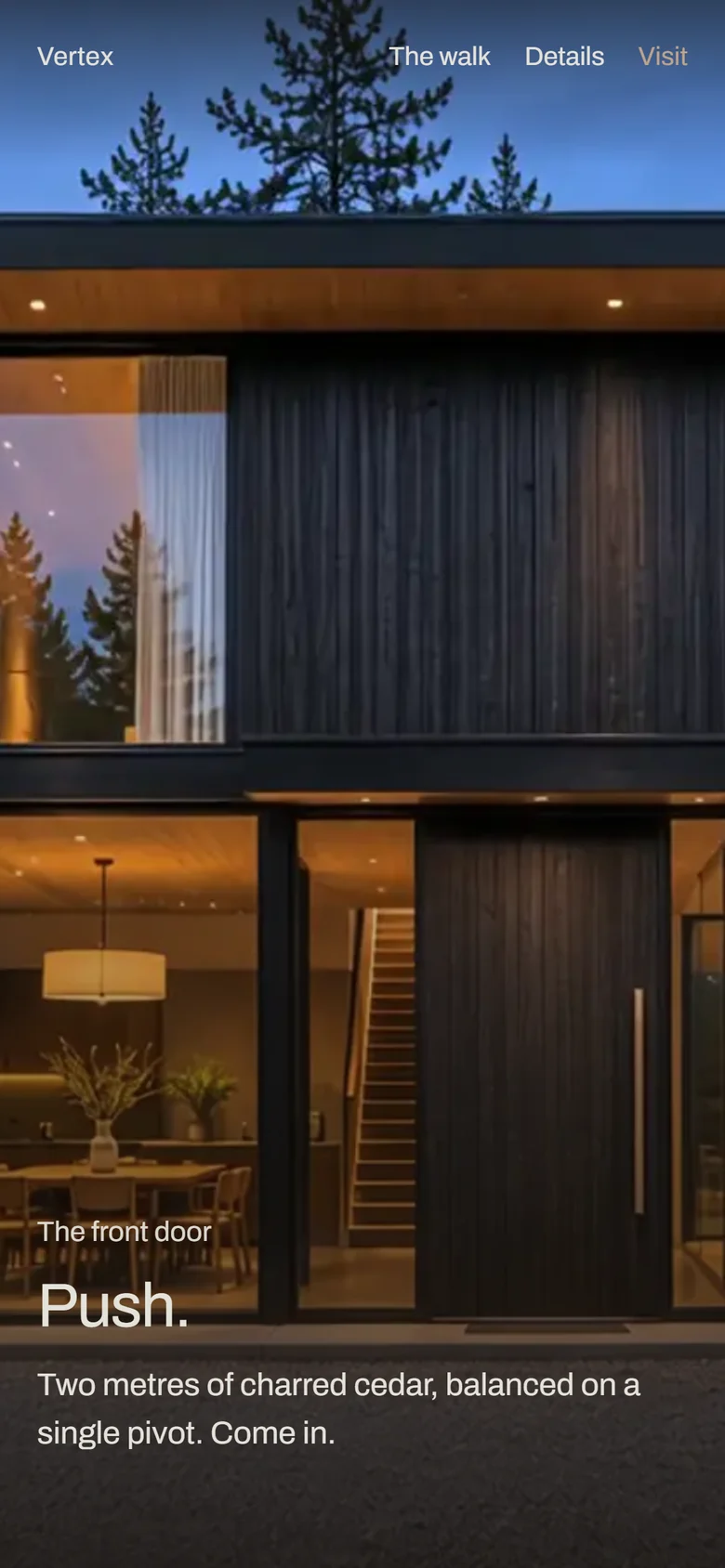
Portrait crop
Phones get their own crop centred on the door.
Caption
Copy sits clear of the picture's focal point.
Key functionality
- Opening sheet: a front-elevation blueprint with title block that builds into the finished house as you scroll
- A fly-down of the ridge in which neighbouring houses assemble in the same way
- A pivot-door moment (“Push.”) that opens onto the first room
- Twelve rooms presented in sequence, each with its own caption
- A Details section built as a route map through the rooms, and a visit request section
- Clear on-page disclosure that the listing is fictional and the images are AI-generated concept images
Key interactions
- Scroll drives the build, the fly-down and the walk
- A drawing-sheet title block and a pointer-following light on the opening sheet
- Header links to The walk, Details and Visit
- A static version for visitors without scripting, with reduced motion or with data saving on, as described in the design packet
Verified technical implementation
- Hand-written site with its own engine script (engine.js) and no framework detected on the published page.
- Scenes are drawn on canvas from WebP image layers and image sequences, not video seeking (from the project's design packet).
- Imagery is AI-generated and labelled as such in the page text. Commercial terms of the image generator remain recorded as unverified in the packet.
- Source and quality-check evidence are kept in a private STS repository and are not published here.
- Known issue: the page's meta description says six rooms while the page says twelve.
What it does
- Opens on a blueprint of the front elevation that builds into the finished house as you scroll
- Flies down the ridge while neighbouring houses assemble
- Pushes to a pivot front door and walks through twelve rooms
- Shows a route-map Details section and a visit request section
- The visit form does not pretend to deliver an inquiry (demonstration)
Anything not marked is implemented in the version shown. Behavior marked demonstration, or in development, is not described as production-ready.
How it was built
- A written design packet set the thesis, palette, type and motion limits before code was written.
- The first version used generated video clips; they could not build a house cleanly, so the build became code-driven layers cut from an aligned blueprint and photograph (design packet, third revision).
- A static version exists for visitors without scripting, with reduced motion or with data saving on.
Technology, as verified. Hand-written HTML, CSS and an engine script (engine.js), no framework detected; Canvas scenes from WebP image layers and sequences; Archivo as the single type family (design packet).
AI. AI image generators produced the house imagery, disclosed on the page. AI-assisted engineering is recorded in the commit history. Decisions on thesis, tools and acceptance were made against a written packet.
Maturity. A proof of concept. The design packet records that an independent 9.5 score was not verified and that real-device, keyboard-only and screen-reader testing are open.
Beyond this business
The transferable capability is turning a physical place or a process into one continuous walk that ends at a real action.
- Real-estate developers and agents. A real property walked through its genuine rooms, with disclosed real photography.
- Hotels, resorts and event venues. A guest’s arrival to rooms, spaces and a booking request.
- Campuses, hospitals and museums. A guided route through spaces visitors worry about finding.
- Vacation-rental owners. A listing that shows the layout and the views before the guest books.
What Business Discovery would decide for a new business:
- Whether real photography exists or generated imagery is acceptable and must be disclosed
- How inquiries should be delivered and tracked
- How heavy the page can be for the audience's devices and connections
- Which rooms, routes or steps genuinely help a visitor decide
These are applications of the capability, not designs to select. A new site would be designed from that business's own answers.
07 · Business value
Demonstrates how a long, rich story can be told through scroll for any product that has a place or a process to walk through, while staying honest about what is invented.
Classification: Proof of Concept. Status: Proof of concept. A scroll-driven real-estate walkthrough with one invented listing. The listing, price and agent are fictional, and the imagery is AI-generated and disclosed on the page. Not a commissioned client project.
Your business
Simplified Tech Solutions does not build businesses around website templates. We design digital experiences around the business itself. Every project begins with Business Discovery: understanding what the business does, who it serves, how it operates, and what its digital experience must accomplish.
These concepts exist to demonstrate capability. A real project is not assembled from one of them; it begins with Business Discovery, and the design and engineering are decided from what that conversation finds. This page does not claim that any concept shown here began with a discovery session unless its own record says so.