
Proof of Concept
Live Demonstration
An American obsession.
Proof of concept. A cinematic scroll film for a smash-burger concept. Not a commissioned client project.
01 · Purpose
A smash-burger site told as one scroll film: the camera pushes into the burger, it turns on screen, opens into its seven layers, hits the griddle, travels through a century of American burger culture and lands on the menu.
Disclosure. SMASH is a concept built to demonstrate this kind of site. The period scenes, ingredient cut-outs and griddle shots are AI-generated concept imagery, and the period scenes are labelled on the page as re-creations, not archival photographs. Location, hours and prices are placeholders.
02 · The problem
Food sites tend to show a photo grid and a menu. The goal here was the opposite: make a visitor want to eat the burger, not just admire the animation, while still reaching the menu and the visit details quickly.
The business it represents. A smash-burger restaurant concept.
Who it serves. A hungry visitor deciding where to eat, who should want the burger within seconds and find the menu and address without hunting.
Deployment status
Publicly reachable at its own Vercel showcase address without signing in. Opened anonymously on 2026-11-13 and the film played from the opening headline to the menu. It is a Vercel project address, not a custom domain.
A concept built to demonstrate a cinematic food site. Location, hours and prices are placeholders.
Status checked on 2026-11-09. A status is a statement about what was tested that day, not a promise about tomorrow.
03 · Design approach
Char black, cream and one cheddar accent, set in Alfa Slab One for every headline and Barlow for reading. The food stays the subject in every scene: the headline sits beside the burger, never on it, and the timeline photographs are rounded, lit cards that lift off the page.
04 · Annotated desktop captures
Real captures of the published site. Numbered points are explained as the camera moves to each one.
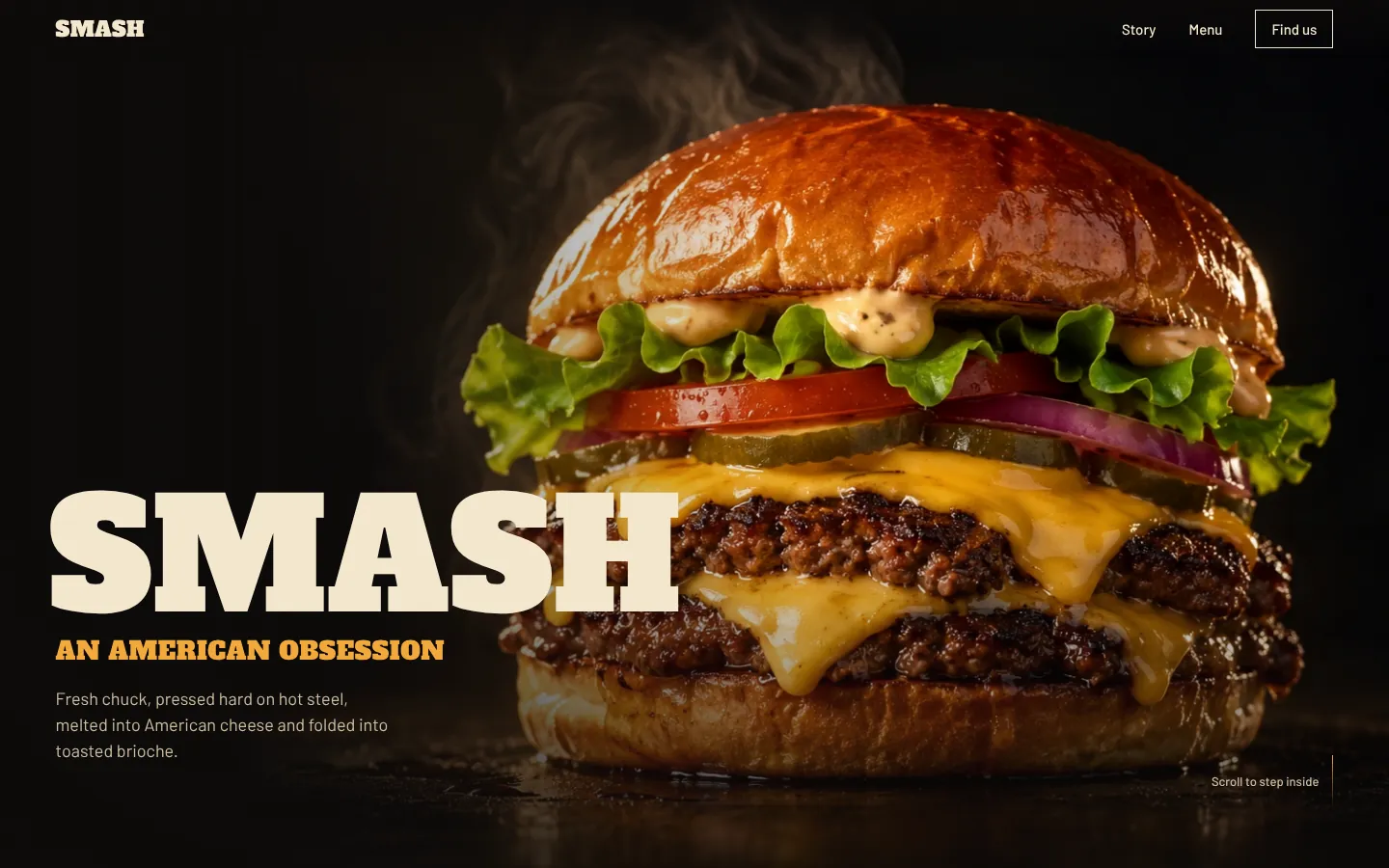
Slam-in headline
Thrown in from the left on load, it lands with a squash and a quick shake of the photo.
Food first
The burger sits beside the headline, so the word never covers it.
Type system
Alfa Slab One for every headline, Barlow for reading.
Step inside
Scrolling pushes the camera into the photo, through the cheese.
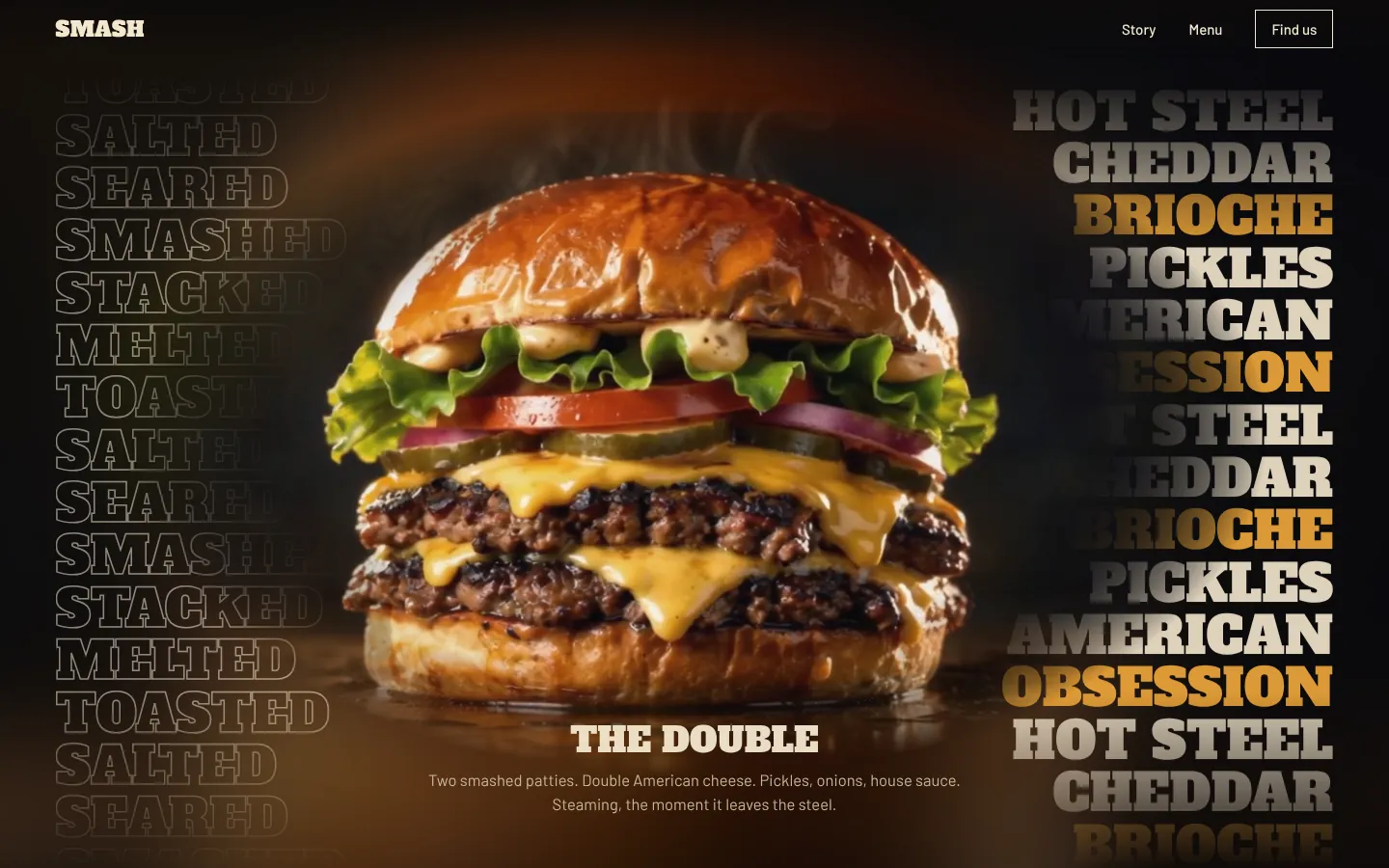
The turning burger
The supplied video rises out of a golden light and turns as you watch.
Outlined words climb
One column rises with the scroll.
Solid words fall
The other column moves the opposite way.
What is in it
A plain caption names the burger under the motion.
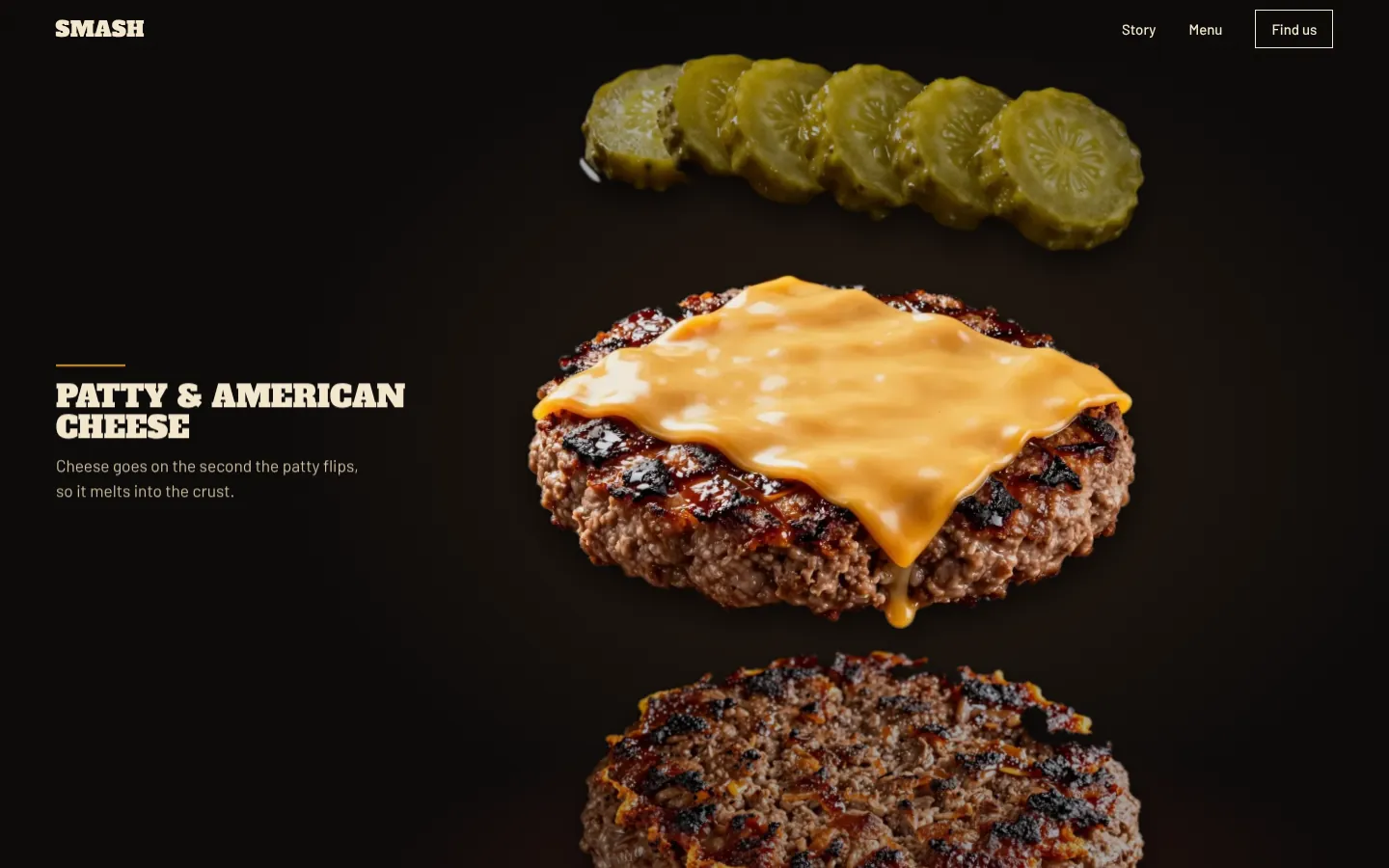
Seven cut-out layers
The stack opens and the camera travels down it one layer at a time.
One note per layer
What the layer is, and why it is there.
Real spacing
Layers are spaced by their own height, so none hides behind another.
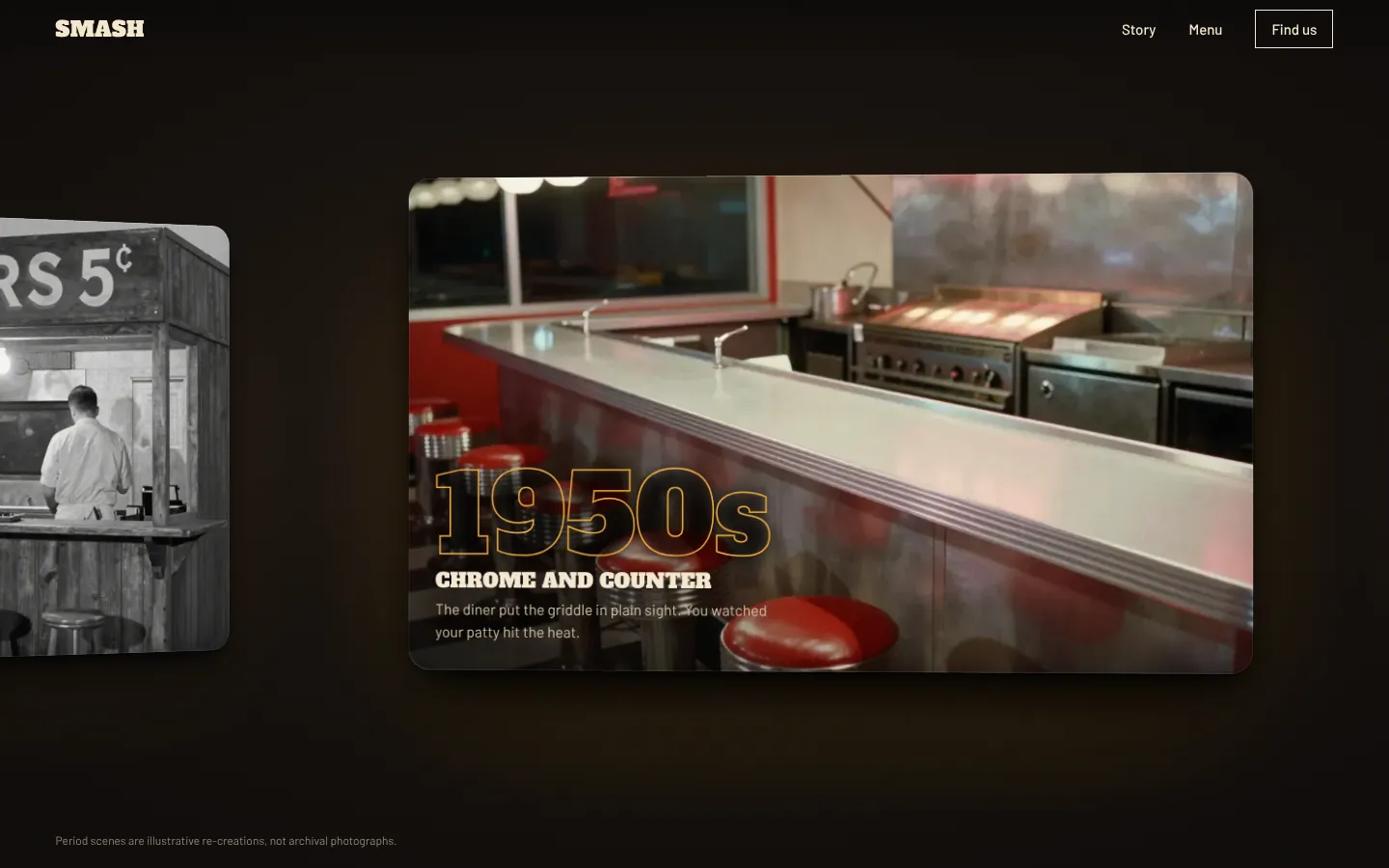
The centre card lifts
Rounded corners, layered shadows and a warm glow; it straightens and grows at the centre.
Neighbours recede
Cards to either side turn away and drop back.
Decade and story
An outlined decade with one short line of history.
Honest label
The period scenes are marked as re-creations.
05 · Responsive behaviour
From desktop to phone
05 · Responsive behaviour
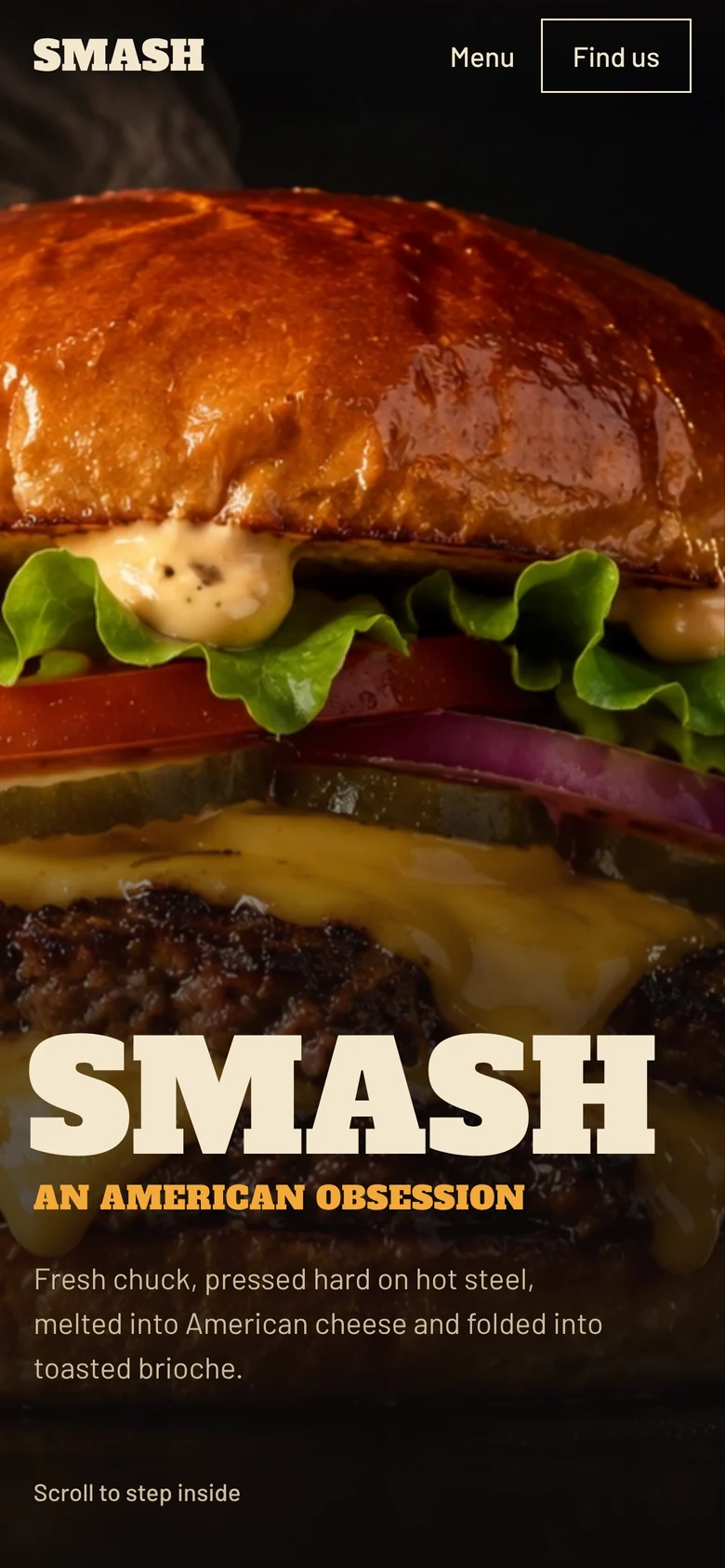
On a phone the photograph fills the screen above the headline, the moving word columns shrink and sit above the caption, the burger layers open down the screen with each note beneath them, and the timeline cards switch to portrait.
06 · Annotated mobile captures
Same slam-in
The entrance plays at phone width too.
Photo fills the screen
The burger leads; the words sit below it.
Readable lede
One short sentence about how it is made.
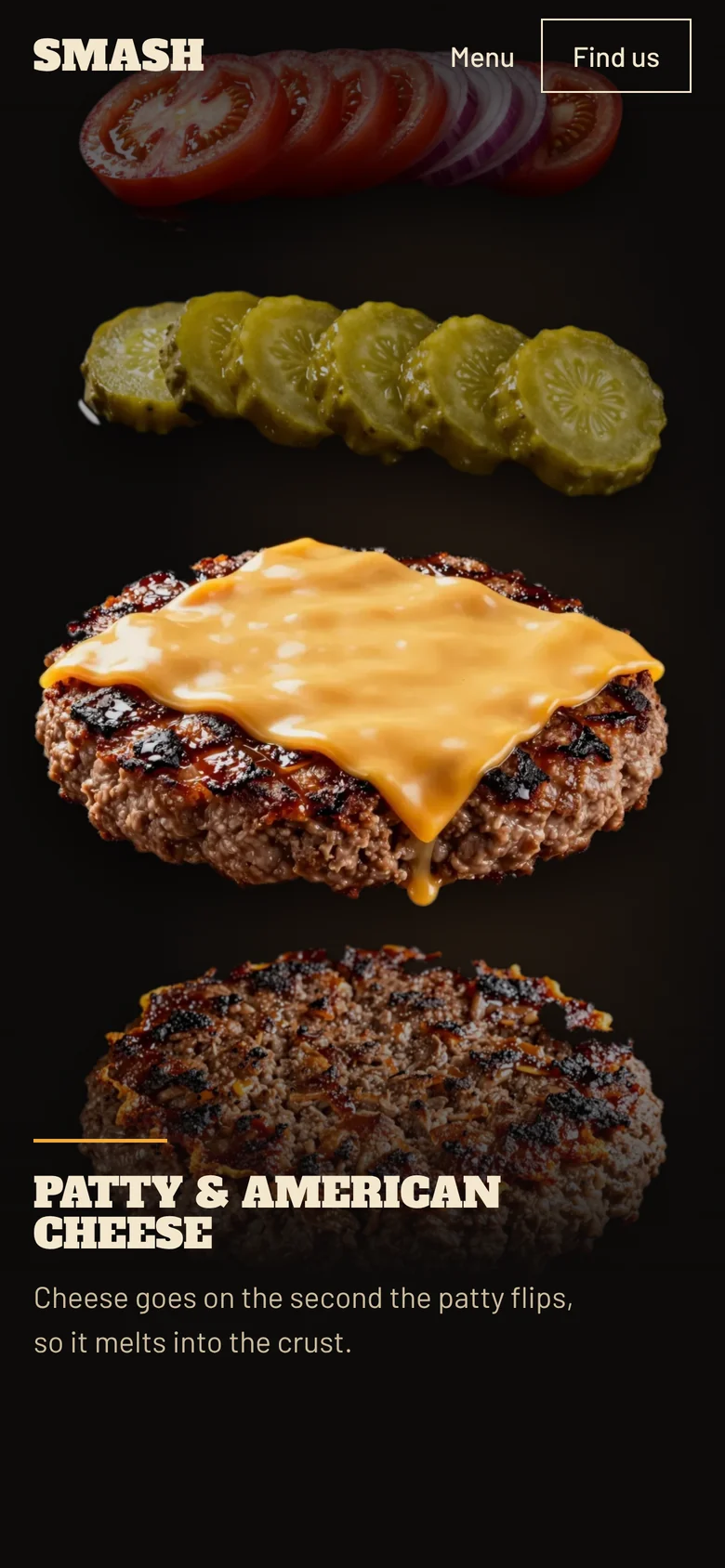
Layers down the screen
The burger opens vertically to suit a tall screen.
Note under the stack
The layer note moves beneath the food instead of covering it.
Key functionality
- An opening headline that slams in from the left and lands with a squash and a split-second shake of the photograph
- A camera push through the hero photograph into molten cheese
- The turning burger rising out of a golden light, framed by two columns of moving words
- An exploded burger: seven cut-out layers open from a stacked burger, one note per layer
- A griddle sequence (Smash, Crust, Melt) with a temperature read-out and cook timer
- A horizontal timeline of the 1930s, 1950s and 1960s on rounded cards that come forward as they reach the centre
- A finale that leads straight to the menu and visit details
Key interactions
- Ordinary scrolling drives the whole film; nothing scroll-jacks and the page can be read top to bottom
- Skip to the menu link and header links to Story, Menu and Find us
- Visitors with reduced motion get a still, readable layout and a “Watch it turn” button instead of autoplay
- Pages without scripting show the same content as a plain, readable page
Verified technical implementation
- React with TanStack Start. One scroll engine written for the project drives every scene; no animation library is used.
- The turning burger is the supplied video drawn onto a canvas. If a browser refuses autoplay, a frame sequence cut from the same video takes over, and the video is only fetched as the visitor approaches it.
- Headline and body fonts are served with the site and preloaded, so the headline never paints in a fallback face.
- Checked in a desktop and a phone-sized browser: the entrance, every scene, the timeline cards, reduced motion and the no-script layout.
What it does
- Slams the headline in on arrival, then pushes the camera into the burger
- Shows the burger turning, then opens it into seven labelled layers
- Walks through a griddle sequence and a century of American burger culture
- Ends on the menu with prices and the visit details (demonstration)
Anything not marked is implemented in the version shown. Behavior marked demonstration, or in development, is not described as production-ready.
How it was built
- Appetite over spectacle: every scene keeps the food as the subject and the headline beside it, not on it.
- One scroll timeline drives every scene, with cross-dissolves instead of hard cuts, and a still layout for reduced motion.
Technology, as verified. React with TanStack Start; A scroll engine written for the project; no animation library; Alfa Slab One and Barlow, served with the site.
AI. The period scenes, ingredient cut-outs and griddle shots are AI-generated concept imagery, and the period scenes are labelled on the page as re-creations.
Maturity. A proof of concept checked in desktop and phone-sized browsers, including reduced motion and the no-script layout.
Beyond this business
The transferable capability is turning one signature product into a short film that sells it, then handing the visitor to the practical page.
- Restaurants and burger bars. The signature dish told as a scroll film, ending on the menu and the order button.
- Bakeries and coffee roasters. A making-of sequence from raw ingredient to finished product.
- Food and drink brands. An exploded view of what is inside, with a clear route to where to buy.
- Product makers. Layer-by-layer anatomy of a product that shows its craft.
What Business Discovery would decide for a new business:
- Which dish or product carries the story, and whether real photography or video exists
- How much motion suits the audience, devices and data plans
- What must stay true to the actual menu, prices, hours and address
- Where the visitor goes next: order online, reserve, or visit
These are applications of the capability, not designs to select. A new site would be designed from that business's own answers.
07 · Business value
Shows how a restaurant or food brand can turn one signature product into a short film that sells appetite, then gets out of the way for the menu.
Classification: Proof of Concept. Status: Proof of concept. A cinematic scroll film for a smash-burger concept. Not a commissioned client project.
Your business
Simplified Tech Solutions does not build businesses around website templates. We design digital experiences around the business itself. Every project begins with Business Discovery: understanding what the business does, who it serves, how it operates, and what its digital experience must accomplish.
These concepts exist to demonstrate capability. A real project is not assembled from one of them; it begins with Business Discovery, and the design and engineering are decided from what that conversation finds. This page does not claim that any concept shown here began with a discovery session unless its own record says so.